Sunday, 26 April 2015
Friday, 24 April 2015
Muscari comosum
Muscari comosum White tassel hyacinth
Gutarrillo
I found this white form of the Tassel hyacinth yesterday. Rather nice to see among the normal blues. it flowers from April to June and can grow from 10~40cms tall. It is native to the Mediterranean as far east as Iran. The bulb is edible and eaten in some countries.
Limodorum abortivum
Limodorum abortivum Violet Limodore
This Limodore is native to eastern Europe, west Asia and the Mediterranean. It grows from 20~85cms tall in open woodlands.It is a herbaceous rhizomatous plant, containing 10~20 flowers. The leaves are reduced to scales. It seeds freely and the seeds remain below ground for 8~10 years before flowering. They flower from April to June.
Wednesday, 22 April 2015
Tuesday, 21 April 2015
Sanguisorba minor
Sanguisorba minor Salad burnet
Pimpinala menor
This lovely little plant is native to much of western and southern Europe, north Africa and SW Asia. It flowers from March to September and grows from 10~50cms tall. It's leaves can be used in salads and dressings and used to be used in the relief of diarrhoea.
Sunday, 19 April 2015
Ophrys speculum ssp speculum
Ophrys speculum ssp speculum Mirror speculum
Orquídea espejo
The top photograph was taken today, and the lower photo shows how it should look. It is not very common to find one without the blue colour pigment, but there are a few populations of the rarer one around. It grows from 5~30cms tall and flowers from February to May. It is native to south of the Iberian peninsula.
Monday, 6 April 2015
Zantedeschia aethiopica
Zantedeschia aethiopica Lords and Ladies
Cala
This beautiful plant is appearing in our garden and in the countryside around us. It can be invasive in places. It is native to North and South Africa and the Middle East. It grows from 30~60cms tall and will eventually produce showy red berries. It is an herbaceous perennial and flowers in April and May.
Friday, 3 April 2015
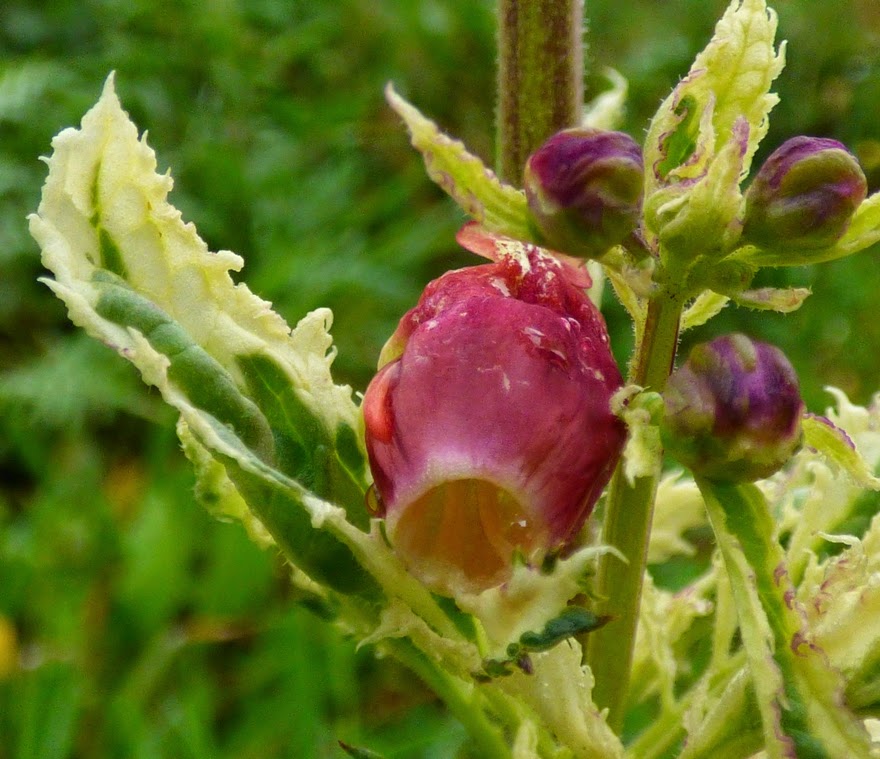
Scrophularia sambucifolia
This is a wonderfully named plant, and I found this variegated form standing next to it's normal green form last week. It grows from 50cm to 1m and is found in dampish places usually, though this was on a dry bank. It is endemic to the southern Iberian peninsula and west Mediterranean, It flowers from March to May.
Saturday, 28 March 2015
Ophrys fusca ssp bilunulata
Ophrys fusca ssp bilunulata Sombre bee orchid
We found this Ophrys fusca yesterday, 27.3.2015 and it has been confirmed as a subspecies by a botanist from Granada. It was about 15cms tall and growing in the mountains. It is native to west Mediterranean and grows from 10~40cms tall. It is found in thickets, pastures and forest clearings. This one was found on a verge by a road.
Monday, 23 March 2015
Mirabilis jalapa
Mirabilis jalapa Four o'clock plant
Don Diego
This pretty plant, native to South America, has naturalised in lots of tropical and temperate areas, as it has here in places. Once you have it, the roots will become enormous and it is difficult to eradicate. Some plants have different coloured blooms on the same stem. They do not flower until late afternoon, hence the name, and are highly perfumed. They are pollinated by long tongued moths. It is often mistaken for the Tobacco plant, Nicotiana which is an annual. This is a perennial plant.
Stellaria media
Stellaria media Common chickweed
Pamplina
This very common chickweed is present all over Europe and north America. What I didn't know was that is is totally edible and nutritious especially when used raw in salads.In folklore it was used to treat itchy skin conditions and respiratory diseases. It can be used as a poultice for cuts and burns. It grows from 2cms to 15cms tall. It does contain SAPONINS which in great quantity (many kilos) can be toxic. Not to be eaten during pregnancy or breastfeeding.
Sunday, 22 March 2015
Saturday, 21 March 2015
Thursday, 19 March 2015
Wednesday, 18 March 2015
Anacamptis collina or O. saccata
Tuesday, 17 March 2015
Ophrys fusca
Ophrys fusca Sombre bee orchid
This Orchid is widespread in the Mediterranean, from Portugal to Turkey. It flowers from February to April, and can often be missed as it hides away sometimes, under oak trees and in among bushes. It is usually from 15~30cms tall. This one has unusual markings, but the O. fuscas do vary considerably. Photographed 16.3.2015 Montejaque.
Sunday, 15 March 2015
Narcissus cerrolazae
Narcissus cerrolazae Montecorto narcissus
This wonderful daffodil is native to specific areas in Andalucia .This species flowers from February to April and grows from 20~40cms tall. It is often confused with Narcissus jonquilla ssp fernandesii, which is NOT present in this area. It has rush like leaves and prefers a damp soil, often found near streams. I have had to correct this as it isn't a jonquil. I KNEW that someone would correct me. Narcissi are changing names all the time here, and I am finding it all very confusing. This is definitely N. cerrolazae. I found some flowering today. 15.1.2016
Family of Plant shown:
Amaryllidaceae
Tuesday, 10 March 2015
Narcissus cuatrecasasii/arundanus
Narcissus cuatrecasasii/arundanus Rush leaf jonquil
Narciso amarillo
This tiny, delicate Narcissus only grows to a maximum of 15cms tall. The plants I saw today were much smaller. It is a native of Spain and southern France. If you are lucky enough to get close to it, it has a delicate perfume. It flowers from February to April in rocky sheltered areas.
Family of Plant shown:
Amaryllidaceae
Subscribe to:
Posts (Atom)